


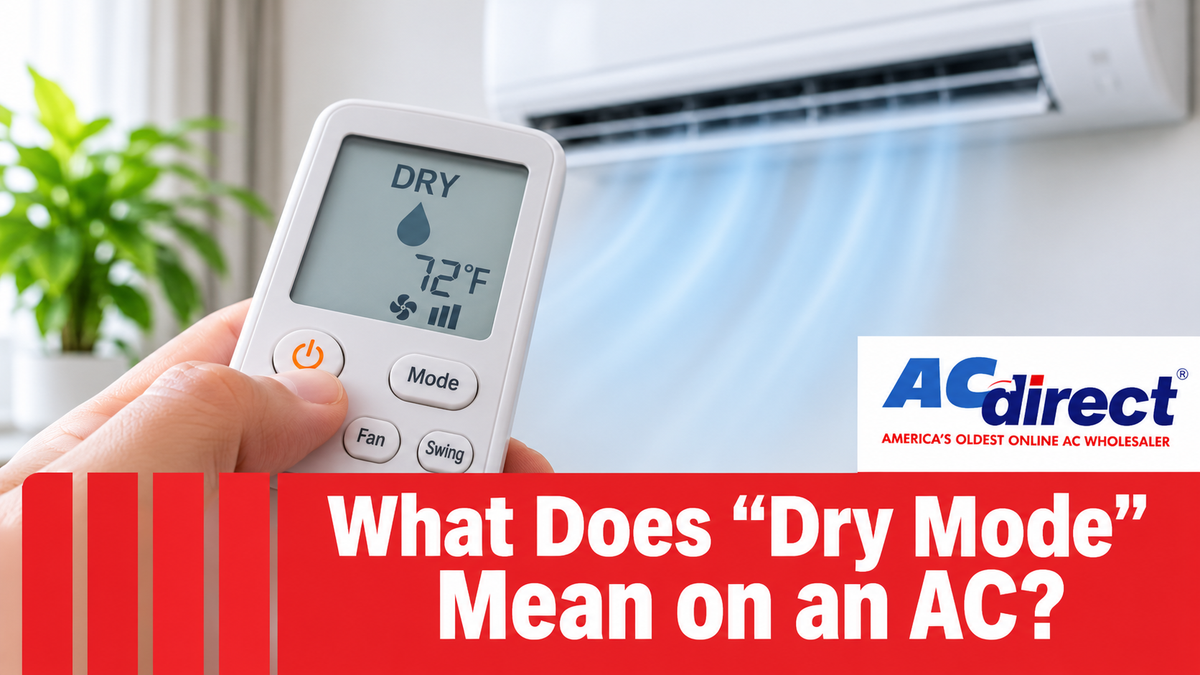
What Does "Dry Mode" Mean on an AC?
What the water-droplet setting on your remote actually does, when it beats cool mode, and where it falls short.
Dry mode is a setting on your air conditioner that pulls moisture out of the air without cooling the room much. It runs the compressor in short, low-power bursts and slows the fan down, so the unit focuses on humidity instead of temperature. Most ductless mini-splits, window units, and portable ACs have it, usually marked with a water droplet icon on the remote.
If you've ever wondered why your AC has a setting that isn't "cool" but isn't "off" either, this is it. Here's when it actually makes sense to use, how it's different from regular cooling, and where it falls short.
How Dry Mode Actually Works
In normal cooling mode, your AC runs the compressor and fan at whatever speed is needed to hit your target temperature. In dry mode, the compressor still runs, but the fan slows way down and cycles on and off more than it would in cool mode. Less air moving across the cold evaporator coil means more time for moisture in that air to condense and drain away, which is exactly how dehumidification happens in any AC system.
The side effect is that the room does cool down a little, since the compressor is still running, but that's not really the point. Temperature control takes a back seat to humidity control.
Dry Mode vs. Cool Mode
On a muggy day where the temperature itself isn't unbearable, say 75-78°F, but the air feels sticky and heavy, cool mode can actually overshoot. You end up cranking the AC down further than you'd like just to get relief from the humidity, and the room ends up colder than you actually wanted. Dry mode skips that overcorrection. It strips out the moisture that's making the air feel worse than the thermometer says it is, so the room feels more comfortable without needing a big temperature drop.
It also tends to use less electricity than cool mode, since the compressor isn't working as hard or as continuously. That's not the main reason to use it, but it's a nice side benefit.
When Dry Mode Makes Sense
Dry mode is most useful during shoulder-season weather, think early summer, late spring, or a rainy stretch, when humidity is high but the outdoor temperature isn't. It also works well overnight, when you want the air to feel comfortable without waking up cold from an AC that's been blasting all night.
- Humid but mild days where full cooling feels like overkill
- Bedrooms at night, especially if you tend to get cold under a blanket with the AC running
- Basements or rooms that already run a little damp
- Rainy season in climates where summer humidity shows up before the real heat does
Where Dry Mode Falls Short
It's not a replacement for cooling on genuinely hot days. Because the compressor cycles at low power, dry mode won't keep up once the temperature climbs into the high 80s or 90s. You'll want regular cool mode for that.
It's also not the same as running a dedicated dehumidifier. A whole-home dehumidifier or a standalone unit is built to pull moisture out of the air continuously and can handle a much bigger space or a more humid environment than an AC's dry mode was ever designed for. Dry mode is more of a comfort feature for the room you're in right now, not a fix for a consistently damp house.
Does Every AC Have Dry Mode?
Most ductless mini-splits and inverter-driven systems have it built in, since the variable-speed compressor makes it easy to run at that low, steady output. ENERGY STAR notes that variable-speed compressors can continuously adjust output instead of just switching on and off at full power, which is exactly the mechanism that makes a good dry mode possible. Standard single-stage window units and older central AC systems are hit or miss. If you're shopping for a new system and humidity control matters to you, an inverter mini-split is generally your best bet, since the technology that makes dry mode work well is the same technology that makes these systems more efficient overall.
Frequently Asked Questions
Does dry mode cool the room at all?
A little. The compressor is still running, so there's some cooling effect, but it's much milder than cool mode and isn't meant to be the main event.
Can I run dry mode all day?
Yes, it's safe to leave it running for extended periods. Just keep in mind it won't keep up if the temperature rises significantly.
Is dry mode the same as a dehumidifier?
Not quite. It removes some humidity as a byproduct of running the compressor, but a dedicated dehumidifier is built to do that job more thoroughly and for a larger space.
Why does my room feel more comfortable in dry mode even though it's warmer than in cool mode?
Humidity affects how warm the air feels more than most people realize. Lower humidity at the same temperature almost always feels more comfortable, which is the whole idea behind dry mode.
Looking for a system with reliable dry mode performance? Browse our ductless mini-split systems or check out our full lineup of inverter AC units.


