


MrCool 36000 BTU DIY Mini Split Heat Pump AC Wall Mount Indoor Unit System | 18 SEER2 5th Generation DIY 230V | R454B
Free Shipping over $1,500

MrCool DIY 5th Gen 2 Zone 18000 BTU Mini Split Heat Pump System - Choose Your Indoor Units - R454B
Free Shipping over $1,500

MrCool DIY 5th Gen 2 Zone 48000 BTU Mini Split Heat Pump System - Choose Your Indoor Units - R454B
Free Shipping over $1,500

MrCool DIY 5th Gen 2 Zone 27000 BTU Mini Split Heat Pump System - Choose Your Indoor Units - R454B
Free Shipping over $1,500

MrCool 18000 BTU DIY Mini Split Heat Pump AC Wall Mount Indoor Unit System | 22.5 SEER2 5th Generation DIY 230V | R454B
Free Shipping over $1,500

MrCool DIY 5th Gen 5 Zone 55000 BTU Mini Split Heat Pump System - Choose Your Indoor Units - R454B
Free Shipping over $1,500
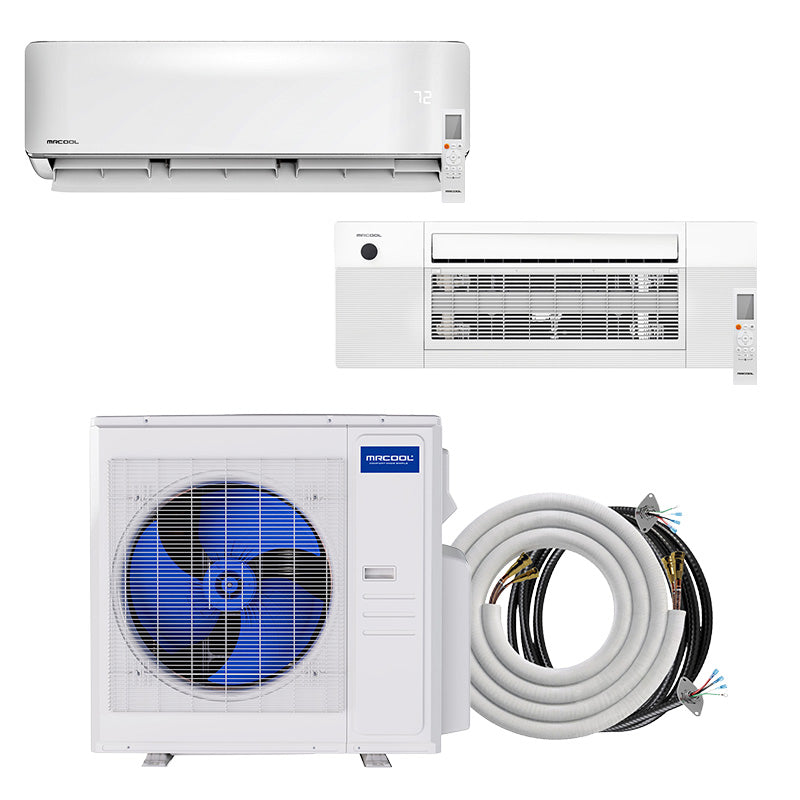
MrCool DIY 5th Gen 4 Zone 36000 BTU Mini Split Heat Pump System - Choose Your Indoor Units - R454B
Free Shipping over $1,500

MrCool 24000 BTU DIY Mini Split Heat Pump AC Wall Mount Indoor Unit System | 22.7 SEER2 5th Generation DIY 230V | R454B
Free Shipping over $1,500

MrCool DIY 5th Gen 2 Zone 55000 BTU Mini Split Heat Pump System - Choose Your Indoor Units - R454B
Free Shipping over $1,500

MrCool DIY 5th Gen 4 Zone 55000 BTU Mini Split Heat Pump System - Choose Your Indoor Units - R454B
Free Shipping over $1,500

MrCool DIY 5th Gen 3 Zone 55000 BTU Mini Split Heat Pump System - Choose Your Indoor Units - R454B
Free Shipping over $1,500

MrCool DIY 5th Gen 3 Zone 48000 BTU Mini Split Heat Pump System - Choose Your Indoor Units - R454B
Free Shipping over $1,500
DIY Mini Split Systems
A DIY mini split is a ductless heating and cooling system built to be installed without a licensed HVAC technician. The refrigerant lines arrive pre-charged and sealed from the factory, which removes the steps that normally require certification and a service call: pulling a vacuum, flaring copper, and handling refrigerant.
For most homeowners that removes the largest single line item on a mini split quote. You buy the equipment and do the work yourself over a weekend.
What makes a DIY mini split different
A conventional mini split ships with an empty line set. An installer has to flare the copper, pull a vacuum, pressure test the system, and release refrigerant from the condenser. That work requires EPA Section 608 certification and tools most homeowners do not own.
DIY systems replace all of it with pre-charged quick-connect line sets. The lines come sealed and filled. You route them, thread the fittings by hand, and open the service valves. No vacuum pump, no manifold gauges, no refrigerant handling.
What still has to be done properly: mounting the indoor head, drilling the wall penetration, setting the outdoor unit on a pad or bracket, running the condensate drain to a suitable discharge point, and connecting power. The electrical side is the part most people underestimate — see MrCool DIY electrical requirements for breaker sizing and wiring before you order.
DIY mini split vs. traditional central HVAC
| DIY mini split | Traditional central HVAC | |
|---|---|---|
| Installation | Homeowner-installable, typically a weekend | Licensed contractor, usually multi-day |
| Ductwork | None required | Requires ducts; retrofitting them adds significant cost |
| Zoning | Each indoor head is its own zone | Whole-house single zone unless dampers are added |
| Energy use | Inverter compressor modulates; no duct losses | Duct losses commonly run 20–30% where ducts pass through unconditioned space |
| Best suited to | Rooms without ducts, additions, garages, single-zone needs | Whole-house conditioning where ducts already exist |
| Upfront cost | Equipment only | Equipment plus installation labour |
If you do have ductwork and are comparing against a full system replacement, our ductless mini splits range covers both ends of that decision.
How to choose the right size
Capacity is measured in BTU. Undersize the system and it runs continuously without reaching setpoint. Oversize it and it short-cycles, which hurts dehumidification and shortens compressor life. Bigger is not safer.
| Capacity | Typical coverage | Common uses |
|---|---|---|
| 12,000 BTU (1 ton) | 450–550 sq ft | Bedroom, home office, small living room |
| 18,000 BTU (1.5 ton) | 700–800 sq ft | Large living room, open-plan area |
| 24,000 BTU (2 ton) | 900–1,100 sq ft | Garage, workshop, two adjoining rooms |
| 36,000 BTU (3 ton) | 1,400–1,600 sq ft | Large open space or a multi-zone setup |
Those are starting points, not a load calculation. Ceiling height, insulation quality, window area and sun exposure all move the number — a room with west-facing glass or a cathedral ceiling needs more than its square footage suggests. Our MrCool DIY sizing guide walks through the adjustments.
Where DIY mini splits work best
Garages and workshops
The most common DIY application, because extending ductwork into a detached or uninsulated garage is rarely worth the cost. A single head handles both heating and cooling, and the space does not need to be tied into the main system at all.
Bedrooms
Quiet operation matters more here than anywhere else in the house. Inverter-driven units run at low speed most of the time rather than cycling hard on and off, which is both quieter and steadier than a window unit.
Home offices and converted spaces
A room that was never part of the original load calculation — a converted attic, a bonus room over a garage, a sunroom — is usually the one room the central system cannot keep comfortable. A dedicated head solves it without touching the rest of the house.
Additions
Adding square footage usually means the existing system is now undersized. A mini split on the new space is almost always cheaper than upsizing the central unit and reworking the duct design.
What to check before you buy
- Line set length. Pre-charged sets come in fixed lengths — commonly 16, 25, 35 and 50 ft. Measure the actual route including bends and drops, not the straight-line distance. You cannot cut a pre-charged line set to fit.
- Electrical capacity. Most single-zone units need a dedicated circuit. Confirm your panel has space and the right breaker size before ordering — see electrical requirements.
- Generation. Specifications, refrigerant and controls differ between MrCool DIY generations. The 4th gen vs 5th gen comparison covers what actually changed.
- Single-zone or multi-zone. One outdoor unit can serve several heads, but multi-zone installs are a bigger job and the line routing needs planning up front. Browse single-zone systems if you are conditioning one room.
- Drain routing. The condensate line runs on gravity and needs continuous fall to a suitable discharge point. This is the most common cause of callbacks on a DIY install — see the drain line guide.
- Warranty terms. DIY systems are designed to be self-installed without affecting coverage, but registration requirements vary. The MrCool DIY warranty breakdown has the detail.
What the installation actually involves
Most single-zone installs are a weekend job for someone comfortable with basic tools. The sequence is:
- Mount the indoor head bracket, level, and mark the wall penetration.
- Core the wall — typically a 3-inch hole, sloped slightly downward to the outside.
- Set the outdoor unit on a pad or wall bracket, clear of obstructions.
- Route the pre-charged line set, feed the condensate drain, and hand-tighten the quick-connect fittings.
- Open the service valves, make the electrical connection, and commission the system.
For a full walkthrough, see how to install a MrCool DIY single-zone system. Ceiling cassette installs differ — that process is covered separately.
How MrCool DIY compares
MrCool is the brand that built the DIY category, and it is the range we stock most deeply — the full line is on our MrCool DIY mini split page. If you are weighing it against the alternatives:
- MrCool DIY reviewsWhat owners report after a season or two of use
- MrCool DIY vs. Mitsubishi
- MrCool DIY vs. Senville
- MrCool DIY vs. Pioneer
- MrCool DIY vs. Easy ProThe two MrCool lines are frequently confused
Why buy from AC Direct
We have been selling HVAC equipment online since before most of our competitors existed — long enough to have seen every way a mini split order can go wrong. We sell direct at wholesale pricing, with no installer markup, which is the whole point of buying a DIY system in the first place.
Our team sizes systems and checks compatibility by phone before you order, not after the pallet arrives. If you are unsure between two capacities or whether your electrical panel can carry the load, call us first.
Frequently asked questions
What is included in a DIY mini split system?
A complete system includes the outdoor condenser, one or more indoor heads, the pre-charged quick-connect line set, mounting hardware, a remote or wall control, and the communication wiring. You supply the electrical connection, the wall penetration, and the condensate drain run.
Do I need to be licensed to install one?
No licence is needed for the refrigerant side, because the lines are sealed and pre-charged — that is the entire design intent. Electrical work is a separate question and local code may require a licensed electrician for the circuit. Check your jurisdiction before you start.
How do I know what size I need?
Start from the room's square footage using the table above, then adjust for ceiling height, insulation, sun exposure and window area. When a room sits between two capacities, the smaller unit running longer usually dehumidifies better than the larger one short-cycling.
Can I install a DIY mini split in a garage or workshop?
Yes, and it is one of the most common applications. Garages are often uninsulated and see wide temperature swings, so size generously and account for any door that opens frequently.
How long does installation take?
A single-zone install is typically a weekend for someone comfortable with basic tools. Multi-zone systems take longer, mostly because of line routing rather than complexity.
Does installing it myself void the warranty?
DIY systems are built to be self-installed without affecting coverage, but most manufacturers require registration within a set window after purchase. Register as soon as the system is commissioned.
What electrical work does it need?
Most single-zone units need a dedicated circuit with a disconnect within sight of the outdoor unit. Breaker size varies by capacity, so confirm the requirement for your specific model before ordering rather than after.


