


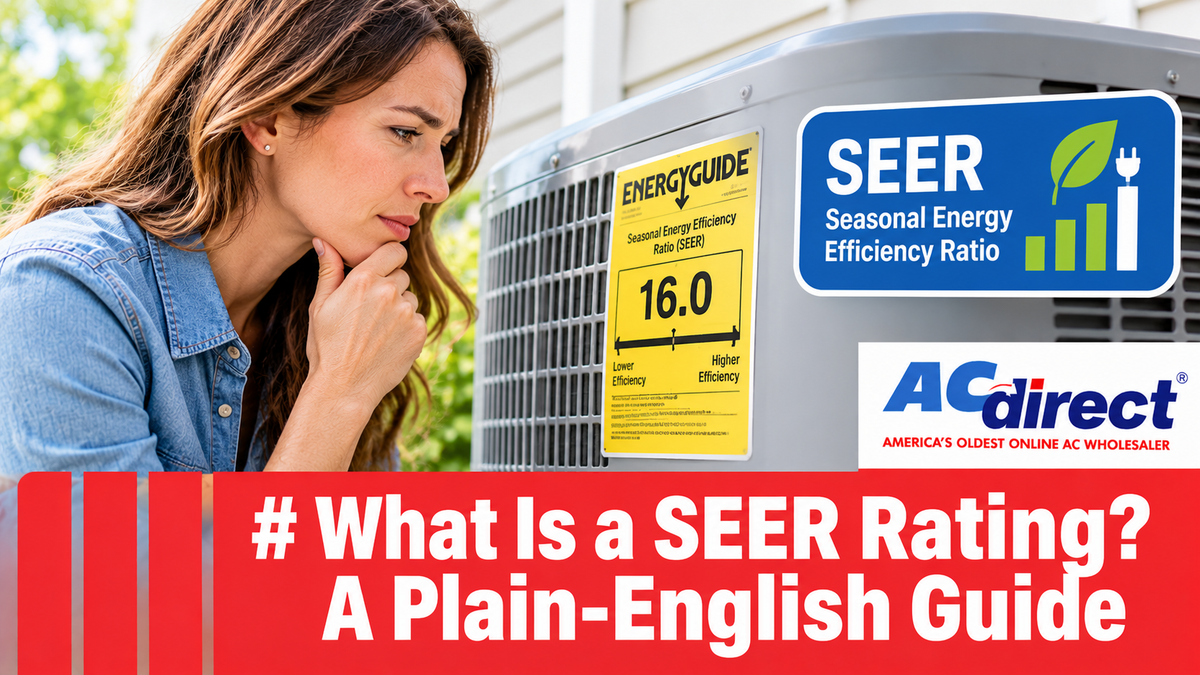
What Is a SEER Rating? A Plain-English Guide
What the number on the sticker actually measures, why it changed to SEER2, and when paying for a higher one is worth it.
SEER stands for Seasonal Energy Efficiency Ratio, and it's the number that tells you how efficiently an air conditioner or heat pump cools your home. You'll usually see it written as SEER2 today, which is the current version of the rating. The higher the number, the less electricity the system uses to produce the same amount of cooling.
How the Rating Actually Works
SEER2 is calculated by taking the total cooling a system produces over a typical cooling season and dividing it by the total electricity it used to produce that cooling. A system rated at 15 SEER2 delivers 15 BTUs of cooling for every watt-hour of electricity it consumes, averaged out over a full season rather than measured at one single moment.
That seasonal averaging matters. Your AC doesn't run at the exact same efficiency on a mild 78°F day as it does during a 98°F heat wave, so SEER2 is meant to reflect real performance across a whole range of conditions, not just a best-case lab test.
Why It's Called SEER2 and Not Just SEER
If you've shopped for a system in the past few years, you've probably noticed SEER2 numbers look a little lower than the SEER numbers you remember from older units. That's not because equipment got less efficient. The Department of Energy changed how HVAC systems are tested starting January 1, 2023, using a testing method that accounts for more realistic ductwork resistance than the old standard did. The new test simulates air having to push through a duct system the way it actually does in a real house, not the more forgiving conditions the original SEER test used.
What Counts as a Good SEER2 Rating
This depends partly on where you live, since the federal minimum is actually set higher in southern states than northern ones because AC systems run so much more of the year there.
| SEER2 range | What it means |
|---|---|
| 13.4 – 14.3 | Current federal minimums (13.4 north, 14.3 south) |
| Mid-teens | Solid mid-range efficiency |
| 18+ | High-efficiency territory — higher upfront cost, lower running cost |
We break this down further, including how to weigh the higher upfront cost against long-term savings, in our guide on what counts as a good SEER rating.
Does a Higher SEER2 Rating Always Save You Money?
Not automatically. The energy savings from a higher-efficiency system add up over years of use, which means how much you run your AC matters as much as the rating itself. A home in a hot, humid climate running the AC nearly year-round will recover the extra upfront cost of a high-SEER2 system faster than a home in a mild climate where the AC only runs a few months a year. If you're only cooling occasionally, a mid-range SEER2 system might make more financial sense than paying extra for a rating you won't use enough to pay back.
SEER2 vs. EER2
You may also come across EER2 on a spec sheet. Where SEER2 measures efficiency averaged across an entire season, EER2 measures efficiency at one specific, demanding condition: 95°F outside, 80°F inside, 50% humidity. If you live somewhere that regularly hits extreme heat, like the desert Southwest, EER2 can actually tell you more about how the system performs when it matters most than the seasonal SEER2 average does.
Frequently Asked Questions
Is SEER2 the same as SEER?
No, though they measure the same basic concept. SEER2 uses a stricter, more realistic testing method adopted in 2023, so SEER2 numbers run slightly lower than SEER numbers for equivalent equipment.
What's the minimum SEER2 rating I can legally buy?
As of 2023, the federal minimum is 13.4 SEER2 in northern states and 14.3 SEER2 in southern states for split systems.
Do I need the highest SEER2 rating available?
Not necessarily. It depends on your climate, how much you run your AC, and your budget. A very high SEER2 system in a home that barely uses AC may never fully pay back its higher upfront cost.
Where do I find the SEER2 rating on a unit I'm considering?
It's listed on the product's spec sheet and on the required FTC EnergyGuide label, and it's listed on every product page in our catalog.
Ready to compare systems by efficiency? Browse our full lineup of air conditioning systems filtered by SEER2 rating, tonnage, and brand.


