


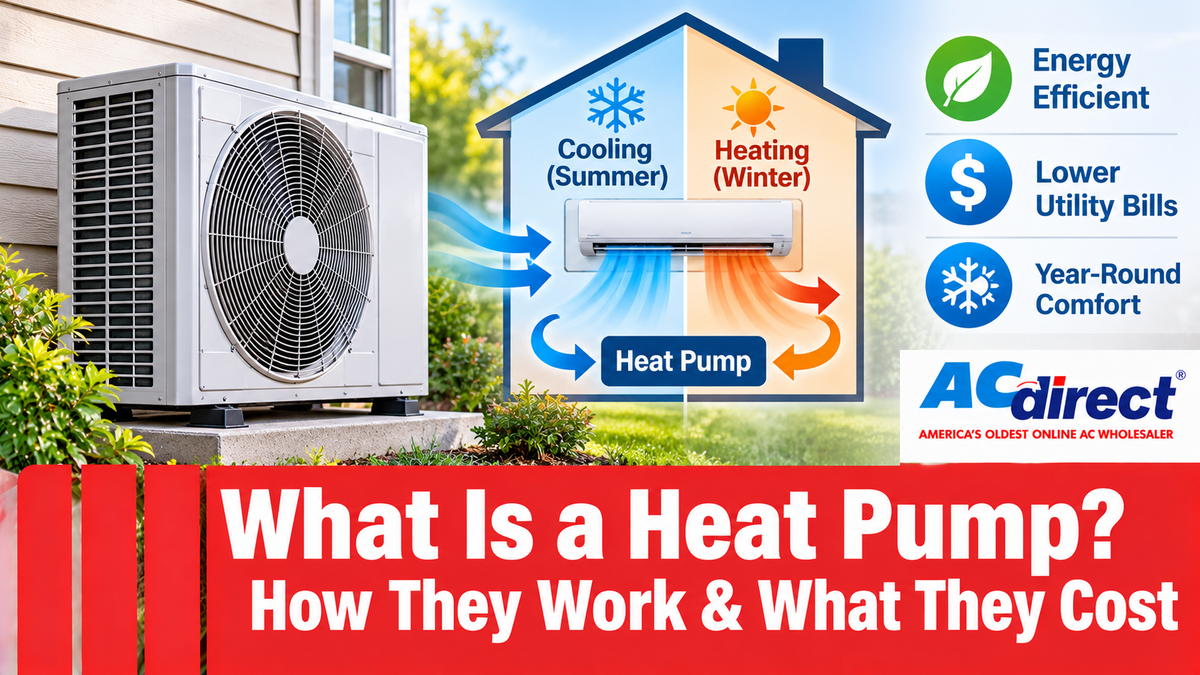
What Is a Heat Pump? How They Work & What They Cost
One system that heats and cools by moving heat rather than burning fuel — how it works, the types available, and what you should expect to pay.
A heat pump is a single system that both heats and cools your home by moving heat from one place to another instead of burning fuel to create it. In summer it pulls heat out of your indoor air and dumps it outside, exactly like an air conditioner. In winter it runs the same process backward, pulling heat out of the outdoor air — even cold outdoor air — and delivering it inside. Most homeowners spend somewhere between $5,000 and $12,000 installed for a ducted air-source heat pump, with equipment alone running roughly $2,500 to $7,000 depending on size and efficiency.
That’s the short version. Below is what’s actually happening inside the system, the different types you’ll run into, and what drives the price up or down.
How a Heat Pump Works
The core idea is that heat exists in air even when that air feels cold to you, and refrigerant can be manipulated to absorb it.
Refrigerant circulates in a closed loop between the indoor and outdoor units. When it’s compressed, it gets hot. When it’s allowed to expand, it gets very cold — cold enough to absorb heat from air that’s already chilly. By controlling where in the loop that compression and expansion happen, the system controls which direction heat travels.
In cooling mode, refrigerant arrives at the indoor coil cold and low-pressure. Your blower pushes warm room air across that coil, the refrigerant absorbs the heat, and cooled air goes back into the room. The now-warm refrigerant travels outside, gets compressed hotter still, and releases that heat to the outdoor air through the condenser coil.
In heating mode, a component called the reversing valve flips the refrigerant’s direction of travel. Now the outdoor coil is the one absorbing heat from the outside air, and the indoor coil is the one releasing it into your home. The hardware is identical. Only the flow changed.
This is why a heat pump can deliver more heating energy than the electrical energy it consumes. It isn’t generating heat, only relocating it, and moving heat takes far less energy than making it. ENERGY STAR puts the range at roughly one and a half to three times more heat energy delivered than electricity used. A gas furnace or an electric baseboard can never exceed 100 percent of the energy it consumes.
What About Really Cold Weather?
There’s less heat available in 10-degree air than in 45-degree air, so output and efficiency both decline as temperatures fall. Older heat pumps struggled badly below freezing, which is where the system’s reputation for being weak in winter comes from.
Modern cold-climate models changed that. Variable-speed compressors and improved refrigerant control let many of them hold most of their rated capacity down to around 5°F, and continue producing usable heat well below zero. If you’re in a genuinely cold region, this distinction matters more than any other spec on the sheet.
The Main Types of Heat Pump
- Air-source ducted split system. The most common setup: an outdoor unit paired with an indoor air handler, distributing air through existing ductwork. This is what most people mean by “heat pump.”
- Ductless mini-split. An outdoor unit connected to one or more wall- or ceiling-mounted indoor heads, with no ducts at all. The right answer for homes without ductwork, additions, and garages. We covered these in detail in how a mini-split works.
- Packaged unit. All components in one cabinet outside the home, typically on a roof or slab. Common in the South and in homes without basements or attic space.
- Dual fuel. An air-source heat pump paired with a gas furnace, switching to gas when it gets cold enough that gas becomes cheaper. See what dual fuel means.
- Geothermal, or ground-source. Exchanges heat with the ground through buried loops rather than with outdoor air. Ground temperature barely moves seasonally, so efficiency stays high year-round. The tradeoff is excavation, which makes installation several times more expensive.
The Efficiency Ratings That Matter
- SEER2 measures cooling efficiency over a season. Current minimums run in the mid-teens; high-efficiency equipment reaches the low 20s.
- HSPF2 measures heating efficiency over a season. Higher is better, and this is the number to weigh most if you’re heating more than cooling.
- COP is instantaneous efficiency at a given outdoor temperature — heat energy out divided by electrical energy in. A COP of 3 means three units of heat per unit of electricity.
- Capacity at 5°F isn’t a rating exactly, but for cold climates it’s arguably the most useful figure on the spec sheet, because it tells you what the system actually delivers when you need it most.
The “2” ratings replaced SEER and HSPF in 2023 under updated DOE test procedures. They’re measured differently and run slightly lower than the old numbers, so don’t compare a SEER2 figure against an older SEER figure directly.
What Does a Heat Pump Cost?
Installed pricing varies enormously by region, home, and contractor. These are typical national ranges for equipment plus professional installation:
| System type | Typical installed cost |
|---|---|
| Ducted air-source split system | $5,000 – $12,000 |
| Ductless mini-split, single zone | $3,000 – $6,000 |
| Ductless mini-split, multi-zone | $6,000 – $15,000 |
| Packaged unit | $5,000 – $10,000 |
| Dual fuel system | $7,000 – $14,000 |
| Geothermal | $15,000 – $35,000+ |
Equipment on its own is a much smaller number — a ducted air-source heat pump and matched air handler generally run $2,500 to $7,000 — which is why buying equipment directly and hiring installation labor separately can change the math significantly.
What Moves the Price
- Capacity. Sized in tons, typically 1.5 to 5 for a house. Bigger costs more, but oversizing is a real problem, not a safety margin — an oversized system short-cycles, dehumidifies poorly, and wears out faster. Sizing should come from a Manual J load calculation, not from square footage alone.
- Efficiency tier. A high-SEER2 variable-speed system can cost several thousand more than a base-model single-stage unit. Whether that pays back depends on your climate and utility rates.
- Ductwork. Existing ducts in good shape keep costs down. Repairs, resizing, or new duct runs add thousands. No ducts at all usually points toward ductless.
- Electrical work. Some homes need a panel upgrade or a new circuit for the outdoor unit and any backup heat strips.
- Backup heat. Electric heat strips are inexpensive to add; pairing with a furnace for dual fuel costs more up front but less to run in deep cold.
- Zones. Each additional indoor head on a ductless system adds equipment and labor.
What It Costs to Run
Operating cost is where heat pumps usually win, and it depends on what you’re replacing.
Against electric resistance heat — baseboards, wall heaters, or furnace heat strips — the savings are large, because you’re replacing a system that delivers one unit of heat per unit of electricity with one that delivers two or three. The Department of Energy notes that today’s heat pumps can substantially cut electricity use for heating compared with resistance heating.
Against a gas furnace, it’s closer and depends on local rates. Where gas is cheap and electricity is expensive, a furnace may cost less to run in deep winter — which is the entire argument for dual fuel. In the shoulder seasons, the heat pump is almost always cheaper.
Against propane or heating oil, heat pumps typically win by a wide margin.
Rebates and Tax Credits
State, local, and utility incentives are still very much alive and in some regions are more generous than the federal credit was. The DSIRE database is the best place to check what applies to your address. Rebate programs change often, so confirm current terms before you buy.
When a Heat Pump Is the Right Call
- You’re replacing an aging AC and a furnace at the same time — one system handles both jobs
- You heat with electric resistance, propane, or oil, where operating savings are largest
- You’re in a moderate climate where a heat pump can cover essentially the whole heating season
- You need heat in a space with no ductwork, where ductless is the practical option
- You want to cut on-site combustion, whether for emissions or indoor air quality reasons
It’s a weaker fit if you have a newer high-efficiency gas furnace with years of life left and very cheap natural gas, in which case adding a heat pump later as a dual fuel upgrade may make more sense than replacing everything now.
Frequently Asked Questions
Does a heat pump work in cold weather?
Modern cold-climate models do, holding most of their capacity near 5°F and still producing heat below that. Older or budget models lose ground faster and lean harder on backup heat.
Is a heat pump the same as an air conditioner?
Mechanically they're nearly identical. The difference is the reversing valve, which lets a heat pump run the refrigerant cycle in both directions. Every heat pump is an air conditioner; not every air conditioner is a heat pump.
How long does a heat pump last?
Typically 15 to 20 years with regular maintenance. Because it runs year-round rather than seasonally, upkeep matters more than it does for a cooling-only system.
Why is my heat pump blowing air that feels cool?
Supply air from a heat pump is usually around 90 to 100°F — warm, but below body temperature, so it can feel cool at the register. That's normal behavior, not a fault.
Do I need backup heat?
In most climates, yes, in some form. Electric heat strips are the common default; a gas furnace in a dual fuel configuration is the cheaper one to actually run.
Ready to compare equipment? Browse our heat pump systems, ductless mini-splits, dual fuel systems and complete system packages from Goodman, Daikin and more.


