


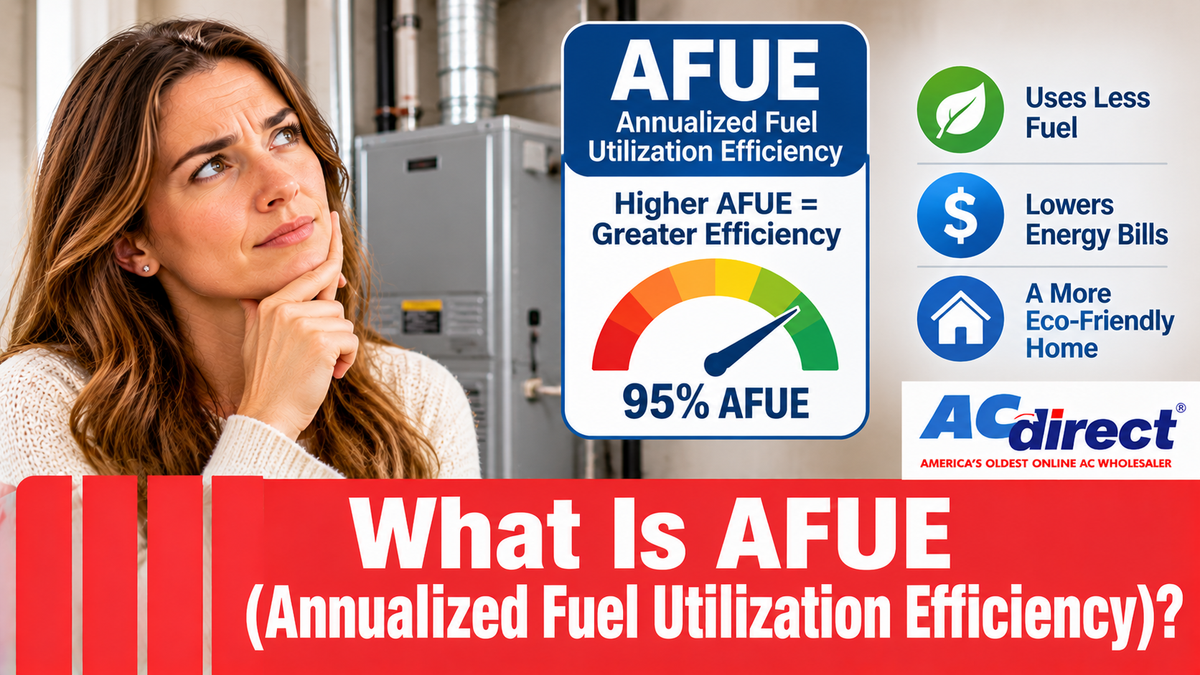
What Is AFUE (Annualized Fuel Utilization Efficiency)?
The number that tells you how much of every dollar of fuel actually ends up heating your house — and how much goes up the flue.
AFUE stands for Annualized Fuel Utilization Efficiency, and it is the percentage of the fuel a furnace burns that gets converted into usable heat over an entire heating season. A furnace rated at 95 percent AFUE turns 95 cents of every fuel dollar into heat inside your home. The other five cents leaves through the flue as exhaust.
It is the single most useful number for comparing two gas or propane furnaces, and it is the heating equivalent of the SEER2 rating you see on air conditioners.
What the “Annualized” Part Means
This is the detail most explanations skip, and it is the reason AFUE is worth trusting.
A furnace running continuously under ideal conditions hits what engineers call steady-state efficiency, and that figure is always higher than the AFUE on the label. But furnaces don’t run that way. They cycle on and off all winter. Every startup wastes a little fuel getting the heat exchanger up to temperature, and every shutdown leaves residual heat to drift away unused.
AFUE accounts for all of that. It is a seasonal average that includes the cycling losses, which is why a furnace advertising 95 percent AFUE is making a more conservative and more honest claim than one quoting a peak efficiency number.
What AFUE Does Not Include
Two significant things sit outside the rating, and both can cost you more than the difference between two AFUE numbers.
- Electricity for the blower. AFUE measures fuel conversion only. The motor moving air through your ducts draws power that the rating ignores entirely. This is why a variable-speed blower can meaningfully lower operating cost without changing the AFUE at all.
- Duct losses. AFUE describes heat delivered into the ductwork, not heat delivered into your rooms. A 96 percent furnace feeding leaky, uninsulated ducts through an unconditioned attic can lose a large share of that heat before it ever reaches a vent.
The practical consequence: sealing and insulating bad ductwork often returns more than upgrading from an 80 percent furnace to a 96 percent one. If your ducts are in poor shape, fix them first.
The Real Dividing Line: Condensing vs. Non-Condensing
AFUE ratings cluster into two groups, and the gap between them is not marketing. It is a genuine difference in how the furnace is built.
Non-condensing — around 80 percent AFUE
A single heat exchanger pulls heat from the combustion gases, and those gases exit still hot — hot enough to rise up a metal flue on their own, and hot enough that the water vapor in them never condenses. Simpler, cheaper, and it vents through a conventional chimney or metal flue pipe.
Condensing — 90 percent AFUE and above
A second heat exchanger extracts additional heat from the exhaust. Pull enough heat out and the water vapor in the combustion gases condenses into liquid, releasing still more energy in the process. That is where the extra 10 to 18 points come from.
It also creates two requirements. The condensate is mildly acidic and has to drain away, so the furnace needs a drain line. And the cooled exhaust no longer rises on its own, so it gets pushed out by a fan through PVC pipe, usually out a sidewall rather than up a chimney.
Why No Furnace Hits 100 Percent
Burning fuel produces exhaust, and that exhaust has to leave the building. It carries heat with it no matter how much you extract first, and there is a floor on how cool you can make it before the furnace stops working properly. Every combustion appliance loses something out the flue.
Electric resistance heating is technically 100 percent efficient, since all the electricity becomes heat with nothing vented. That sounds superior and generally isn’t — the efficiency number describes conversion at the appliance, not what the energy costs you, and resistance heat is usually the most expensive way to heat a home. It is also why heat pumps are rated differently: they move existing heat rather than creating it, so they can deliver more heat energy than the electrical energy they consume.
What AFUE Is Actually Worth in Dollars
Fuel cost scales inversely with efficiency, which makes the math straightforward. Going from 80 to 95 percent AFUE cuts fuel consumption for the same heat output by roughly 16 percent.
The part people miss is that the saving is a percentage of your heating bill, so the size of that bill decides whether the upgrade makes sense.
| If you spend this on gas heat per year | 80% → 95% AFUE saves roughly |
|---|---|
| $1,500 | $237 / year |
| $800 | $126 / year |
| $300 | $47 / year |
Illustrative figures, calculated from the efficiency difference alone. Your actual numbers depend on local fuel rates, your home, and how long your heating season runs.
AFUE, SEER2 and HSPF2: Which Number Applies to What
Equipment that both heats and cools carries more than one rating, and they are not comparable to each other.
| Rating | Measures | Applies to |
|---|---|---|
| AFUE | Heating efficiency, as a percentage | Gas, propane and oil furnaces and boilers |
| SEER2 | Cooling efficiency, as a ratio | Air conditioners and heat pumps |
| HSPF2 | Heating efficiency, as a ratio | Heat pumps in heating mode |
A gas heat system will list AFUE for the furnace and SEER2 for the air conditioner. A dual fuel setup carries all three, because it has both a furnace and a heat pump.
Minimum Standards
The US Department of Energy sets a federal efficiency floor for residential furnaces, and for many years the minimum for non-weatherized gas furnaces has been 80 percent AFUE. A higher federal minimum has been finalized and is scheduled to take effect later this decade, which would end sales of new non-condensing models.
Regional standards can also be stricter than the federal baseline, and ENERGY STAR certification requires efficiency well above the minimum. Before you buy, it is worth confirming what currently applies where you live, since these requirements change on a schedule.
How to Find Your Furnace’s AFUE
- The yellow EnergyGuide label, if it is still stuck to the unit. It states the AFUE directly.
- The nameplate inside or behind the access panel.
- The model number. Many manufacturers encode efficiency into it — an 80 or a 96 sitting in the middle of the string is usually the AFUE.
- The venting tells you which category you are in at a glance. PVC pipe out a sidewall means condensing, so 90 percent or better. A metal flue up a chimney means non-condensing, so around 80 percent.
Frequently Asked Questions
What is a good AFUE rating?
Anything at 90 percent or above is a high-efficiency condensing furnace, and 95 to 98 percent is the top of the current market. But "good" depends on your climate. In a cold region with a long heating season, 95 percent or better is usually worth paying for. In a mild climate where the furnace runs a few weeks a year, an 80 percent unit is often the more sensible purchase.
Is a 96 percent AFUE furnace worth the extra cost?
It depends almost entirely on how much you spend on heating. The savings are a percentage of your fuel bill, so a large bill produces real savings and a small one does not. If your annual gas heating cost is modest, the payback period can easily outlast the furnace.
What is the difference between AFUE and SEER2?
AFUE measures heating efficiency for fuel-burning equipment and is expressed as a percentage. SEER2 measures cooling efficiency for air conditioners and heat pumps and is expressed as a ratio. A system with both will carry both numbers, and they describe completely separate things.
Can a furnace be 100 percent AFUE?
No. Any furnace that burns fuel has to vent combustion gases outside, and those gases carry heat with them. Some energy always leaves through the flue. Only electric resistance heating reaches 100 percent, and it is far more expensive to run despite that number.
Why does a high-efficiency furnace need PVC pipe instead of a metal flue?
Because it extracts so much heat that the exhaust leaves cool enough to condense into liquid. That condensate is acidic and would corrode metal venting, and the cooled gases no longer rise on their own, so the furnace uses a fan and inert PVC pipe routed out a sidewall.
Where do I find my furnace's AFUE rating?
Check the yellow EnergyGuide label if it is still attached, then the nameplate inside the access panel. Failing that, look up the model number on the manufacturer's site. Many model numbers encode it directly, with 80 or 96 appearing in the string.
Shopping for heating? Browse our gas furnaces, AC and gas heat systems, heat pumps and complete system packages.


