


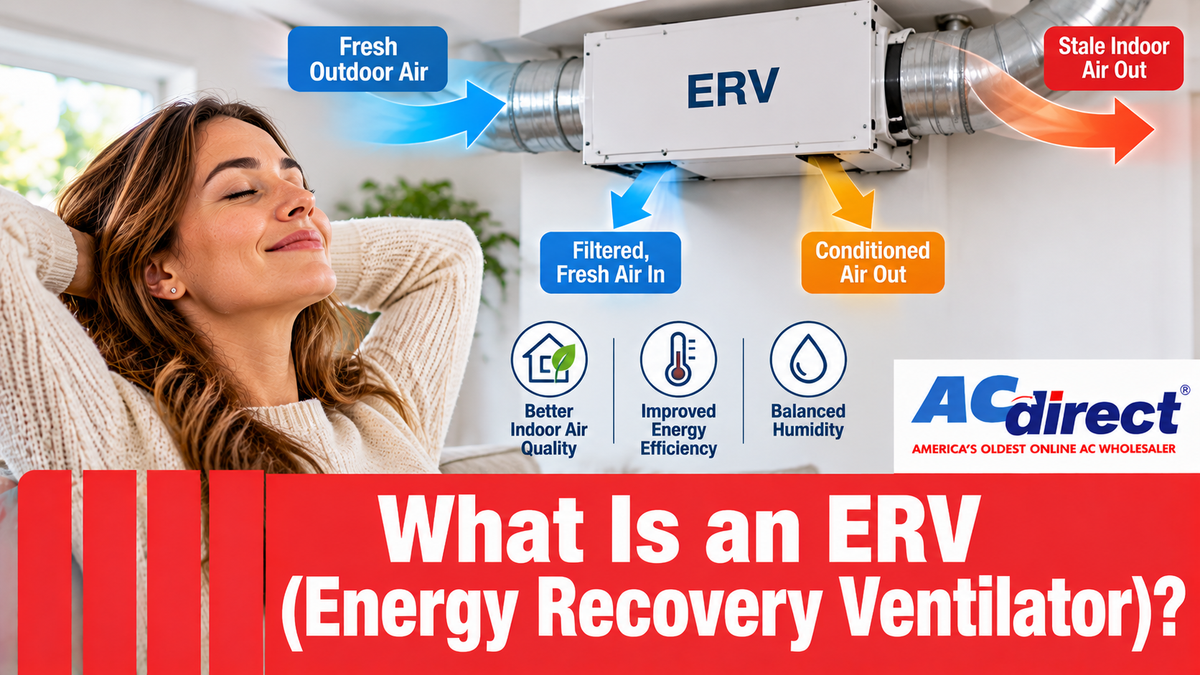
What Is an ERV (Energy Recovery Ventilator)?
Fresh air into a sealed-up house — without throwing away the money you already spent conditioning the air inside it.
An ERV, or energy recovery ventilator, is a device that continuously swaps stale indoor air for fresh outdoor air while capturing most of the heat and moisture from the air on its way out. The two airstreams pass each other inside a component called a recovery core, trading energy without ever mixing. The result is ventilation that doesn’t undo your heating and cooling.
Put plainly: opening a window gives you fresh air and a wrecked energy bill. An ERV gives you the fresh air and keeps most of the energy.
How an ERV Actually Works
An ERV runs two separate airstreams at the same time. One pulls stale air out of the house. The other pulls fresh air in from outside. Both pass through the recovery core, which is built so the two streams flow along either side of a shared surface — close enough to exchange energy, sealed enough that the air itself never crosses over.
What gets exchanged depends on the season. In summer, hot humid outdoor air gives up heat and moisture to the cooler, drier air leaving the house, so it arrives indoors already partly conditioned. In winter, the warm air on its way out pre-heats the cold air coming in. Either way, your HVAC system gets handed air that is much closer to indoor conditions than raw outdoor air would be.
A well-designed core commonly recovers somewhere in the range of 70 to 80 percent of that energy, though the exact figure varies by unit and by operating conditions.
ERV vs. HRV: The Distinction That Matters
These two get used interchangeably, and they shouldn’t be. The difference is moisture.
An HRV (heat recovery ventilator) transfers heat only. An ERV transfers heat and humidity. That single difference decides which one belongs in your house.
| HRV | ERV | |
|---|---|---|
| Transfers heat | Yes | Yes |
| Transfers moisture | No | Yes |
| Best suited to | Cold, dry climates | Hot, humid climates and mixed climates |
| Summer behavior | Brings outdoor humidity straight indoors | Rejects much of that humidity before it enters |
| Winter behavior | Can leave indoor air uncomfortably dry | Retains some indoor humidity |
Why Modern Homes Need This at All
Older houses ventilated themselves, badly but for free, through gaps around windows, doors, framing and attic penetrations. Air leaked in and out constantly. That was wasteful, but it meant the indoor air was always being diluted with outdoor air.
Building practices changed. Tighter envelopes, better sealing, spray foam and improved windows all cut energy waste dramatically — and simultaneously removed the accidental ventilation. A well-sealed house has no path for fresh air unless you build one deliberately.
What accumulates in a sealed house without ventilation:
- Carbon dioxide from the people in it, which is the usual culprit behind stuffiness and afternoon drowsiness.
- VOCs off-gassing from furniture, paint, flooring, adhesives and cleaning products.
- Humidity from cooking, showering, laundry and simply breathing — which, left to build, feeds mold.
- Odors, which have nowhere to go.
The EPA notes that indoor air is frequently more polluted than outdoor air, often substantially so. Ventilation is the fix, and the Department of Energy treats balanced whole-house ventilation as the standard approach for a tight home.
Does an ERV Dehumidify Your House?
No — and this is worth being precise about, because it is the single most common misunderstanding about these units.
An ERV reduces the humidity of the air it brings in. It does not remove moisture from the air already circulating in your home. It lowers the latent load that ventilation would otherwise add; it is not a dehumidifier and it will not rescue a house that already has a moisture problem.
Sizing: How Much Ventilation You Need
Ventilation is sized in CFM — cubic feet per minute of airflow. The widely used residential benchmark comes from ASHRAE Standard 62.2, which sets a whole-house rate based on floor area and occupancy:
CFM = (0.03 × square footage) + (7.5 × [number of bedrooms + 1])
So a 2,000 square foot home with three bedrooms works out to (0.03 × 2,000) + (7.5 × 4), or 60 + 30 = 90 CFM.
That is a baseline, not a final answer. A tighter-than-average envelope, higher occupancy, or specific indoor air quality concerns can all push the requirement upward, and local code may set its own floor. Units are typically specified with some headroom so they can run at lower speed most of the time — quieter, and more efficient.
How an ERV Gets Installed
There are two broad approaches, and which one applies depends mostly on what ductwork already exists.
Fully ducted (independent)
The ERV gets its own supply and return ducts, pulling stale air from bathrooms, laundry and similar spaces and delivering fresh air to bedrooms and living areas. This is the best-performing arrangement because ventilation runs continuously and independently of whether the heating and cooling system happens to be on.
Tied into existing ductwork
The ERV connects to the HVAC system’s return duct and uses the existing distribution. Cheaper and simpler to retrofit, with one meaningful caveat: ventilation is only distributed properly when the air handler’s blower is running. Systems configured this way usually need the blower set to run periodically regardless of whether there is a call for heating or cooling.
What to Look For When Buying
- HVI certification. The Home Ventilating Institute independently verifies airflow and efficiency ratings. Uncertified units are publishing numbers nobody checked.
- SRE (Sensible Recovery Efficiency). The honest efficiency figure, because it accounts for fan energy and heat gain from the motor. Compare units on SRE, not on a headline “up to” percentage.
- Airflow at realistic static pressure. A rated CFM means little without knowing the duct resistance it was measured against. Published figures at 0.4 inches water column or similar are far more useful than a best-case number.
- Core type and serviceability. Cores come as fixed-plate, enthalpy membrane, or rotating wheel designs. The practical question is how easy the core is to pull out and wash, because a core that is awkward to reach is a core that never gets cleaned.
- Defrost provision. Important in climates with hard freezes, where moisture in the exhaust stream can frost the core. Less of a concern across most of the Southeast.
- Controls. Look for variable speed and a humidity or occupancy-based control option. An ERV running flat out around the clock is louder and less efficient than one that modulates.
Maintenance
An ERV is low-maintenance, not no-maintenance, and the failure mode is quiet: it keeps running while slowly delivering less and less.
- Filters — inspect every three to six months, replace or wash as the manufacturer specifies.
- Recovery core — clean once or twice a year, per the manual. Most pull out by hand.
- Exterior hoods — keep intake and exhaust vents clear of leaves, nests and debris.
- Condensate drain — where fitted, confirm it is draining freely.
Frequently Asked Questions
Is an ERV the same as a dehumidifier?
No, and this is the most common misunderstanding. An ERV reduces how much moisture comes in with the fresh air, but it does not pull moisture out of the air already in your house. In a humid climate you may well want both: the ERV handles the ventilation load, a dehumidifier or your AC handles the rest.
Do I need an ERV if I already have an air purifier?
They do different jobs. A purifier filters the air that is already indoors. An ERV replaces it. Filtration does nothing about carbon dioxide, and nothing about the odors and off-gassing that build up in a sealed house.
Can an ERV replace my bathroom and kitchen exhaust fans?
Generally no. Some systems are designed to pull from bath areas as part of a whole-house strategy, but kitchen range hoods in particular should vent grease and combustion byproducts directly outside, not through a recovery core.
Will an ERV make my energy bill go up?
It adds a small amount of fan energy, but it saves considerably more than it costs compared with ventilating by simply opening a window or running an exhaust fan, because it recovers most of the heating, cooling and moisture energy from the air being thrown out.
How often does an ERV need maintenance?
Filters typically get checked every three to six months, and the recovery core usually gets cleaned once or twice a year. Both are homeowner-level tasks on most units. An ERV that nobody services loses efficiency and airflow fairly quickly.
Does an ERV work with a ductless mini-split system?
Yes. Because mini-splits have no ductwork, a home relying on them has no built-in path for fresh air at all, which makes a dedicated ventilation system more important rather than less. The ERV runs on its own small duct network.
Planning a system around better indoor air? Browse our complete HVAC systems, ductless mini-splits and thermostats and controls, or talk to our team about pairing ventilation with your equipment.


